Why ChatGPT is the Worst AI in 2025
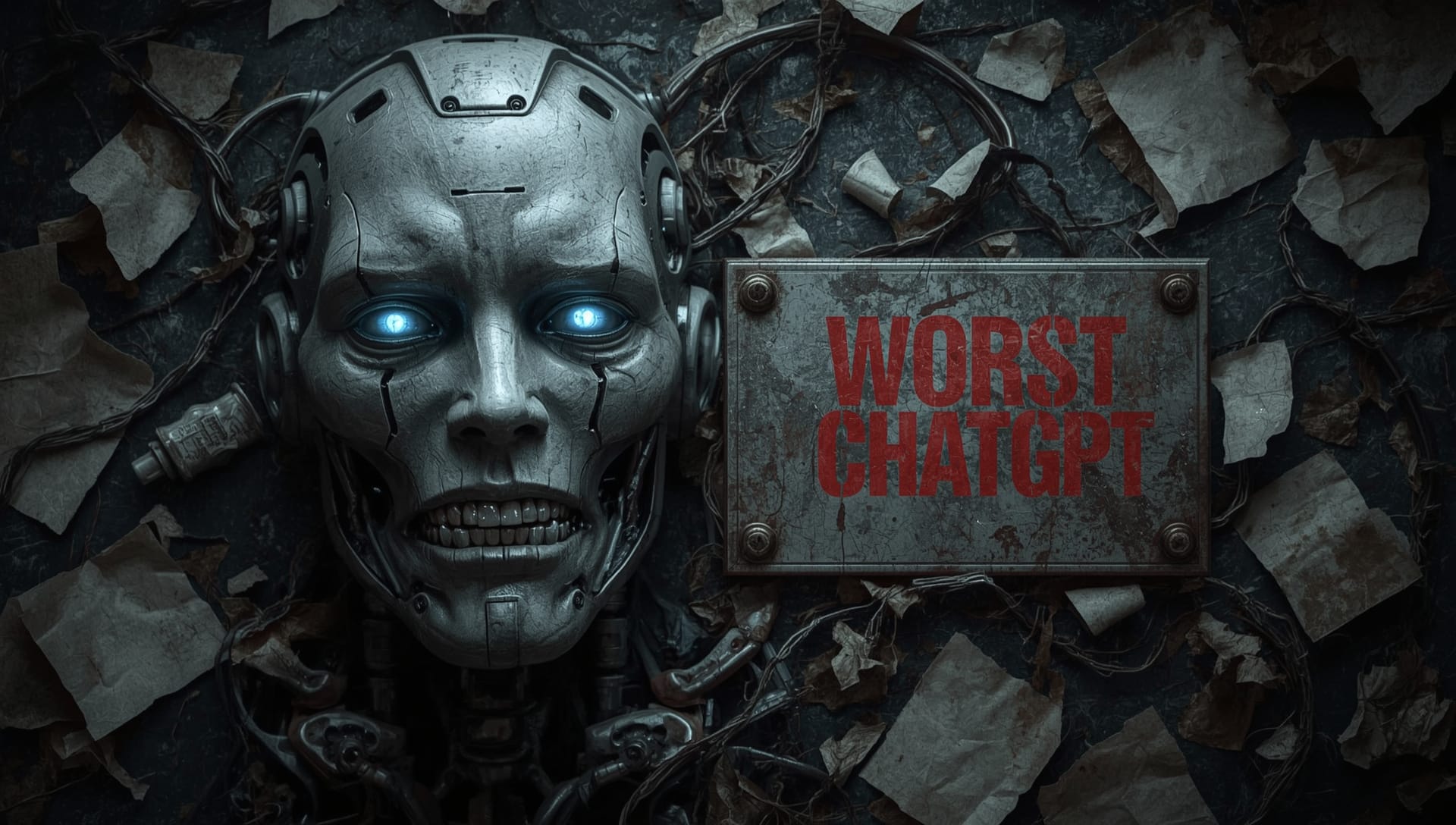
Artificial Intelligence (AI) has become one of the most talked-about technologies of the decade. From healthcare to finance, gaming to content creation, AI has slowly embedded itself into nearly every sector. Among the various AI models, ChatGPT has consistently been at the forefront, gaining massive popularity since its launch. However, as 2025 unfolds, cracks in the shiny facade of ChatGPT are becoming harder to ignore. Once hailed as revolutionary, many experts and everyday users now argue that ChatGPT is no longer the crown jewel of AI—it might even be the worst AI to rely on in 2025.
In this blog, we’ll critically explore why ChatGPT, despite its success, has lost its shine and is increasingly considered outdated compared to the fast-evolving landscape of artificial intelligence. From declining performance and rising competition to trust issues and ethical concerns, here’s why ChatGPT might be more of a liability than an asset in today’s digital world.
1. The Decline of Innovation
When ChatGPT first launched, it was groundbreaking. People were amazed by how fluently it could generate text, answer questions, and simulate human-like conversations. However, by 2025, what once felt revolutionary now seems outdated.
AI competitors such as Anthropic’s Claude, Google’s Gemini, and a new wave of specialized models have surpassed ChatGPT in almost every metric—speed, accuracy, context understanding, and creativity. Users often complain that ChatGPT’s responses feel repetitive, limited, or even “dumbed down” compared to newer models.
What went wrong? OpenAI’s focus shifted toward monetization rather than innovation. While competitors introduced cutting-edge features like real-time reasoning, fact-verification systems, and context retention over months, ChatGPT struggled to keep up. Instead of innovating, it became more restrictive, more cautious, and less useful for advanced problem-solving.
2. Over-Censorship and Restrictions
One of the biggest frustrations for users in 2025 is ChatGPT’s extreme censorship. In its attempt to avoid controversy and misinformation, the model has become overly restrictive, refusing to answer even harmless queries.
For example, ask ChatGPT about certain historical events, political debates, or even adult-level academic discussions, and you’re likely to get vague disclaimers or half-baked answers. This has alienated many users who want nuanced and intelligent conversations.
Meanwhile, competing AIs allow more flexibility, offering factual information with disclaimers instead of outright refusing. ChatGPT’s “over-protective nanny” approach makes it the least desirable option for researchers, professionals, and even casual users who just want balanced information.
3. Declining Accuracy and Hallucinations
One of the core criticisms of ChatGPT in 2025 is its increasing tendency to hallucinate—that is, to produce confident but factually incorrect answers. Instead of solving this issue, it seems to have worsened.
For instance:
- Students have reported incorrect math solutions.
- Journalists cite ChatGPT giving fake references or invented quotes.
- Developers complain it outputs broken or outdated code.
Accuracy was supposed to improve over time, but with the model’s reliance on older datasets and lack of real-time knowledge updates, hallucinations remain a serious problem. Competitors like Google Gemini, which taps directly into live web data, have nearly eliminated this issue, making ChatGPT look outdated and unreliable.
4. Stagnant Knowledge Base
In 2025, most people expect AI to provide up-to-the-minute information. Google Gemini integrates real-time search, Perplexity AI offers dynamic research tools, and even niche AIs in finance, law, and medicine provide current updates.
ChatGPT? Still stuck with outdated knowledge unless users manually connect plugins or external APIs. For an AI tool that markets itself as “the world’s most powerful assistant,” this limitation is unacceptable.
For instance, ask ChatGPT about the latest U.S. tariffs, cryptocurrency updates, or sports results, and it might simply reply, “I don’t have access to real-time information.” In 2025, that makes ChatGPT not just limited—but obsolete.
5. Poor User Experience
Another reason ChatGPT is considered the worst AI in 2025 is the clunky user experience compared to rivals. While competitors offer sleek, adaptive interfaces, ChatGPT still feels stuck in 2023.
- Lack of personalization: Other AIs remember your preferences, tone, and context across weeks. ChatGPT still struggles to retain meaningful memory.
- Laggy performance: As servers are overloaded, many users experience delays.
- Paywalls: Features once free now require expensive subscriptions, making the model less accessible to the public.
As a result, everyday users are migrating toward alternatives that offer smoother, cheaper, and more personalized interactions.
6. Ethical Concerns and Trust Issues
Beyond technical flaws, ChatGPT faces significant trust issues. Over the years, OpenAI has faced backlash for:
- Lack of transparency in how ChatGPT is trained.
- Allegations of bias in responses.
- Data privacy concerns, especially for enterprise users.
By 2025, these issues have snowballed. Governments worldwide are tightening AI regulations, and ChatGPT often finds itself at the center of controversy. Unlike competitors who emphasize openness and ethical guardrails, OpenAI’s reputation has been damaged by secrecy and corporate-driven decisions.
7. Lack of Specialization
The AI industry has evolved toward specialized models. Need legal advice? There’s a law-focused AI. Need medical research? There’s a health-focused model. Want to code? There are developer-first AIs.
ChatGPT, however, remains a “jack of all trades, master of none.” It tries to do everything, but in doing so, it fails to excel at anything. Businesses, students, and professionals now prefer specialized AIs that deliver deeper insights and tailored solutions.
8. Community Backlash
In 2025, public sentiment toward ChatGPT has shifted from excitement to skepticism. Online forums, Reddit communities, and tech review platforms are filled with posts criticizing its decline. Users often describe it as:
- “Too dumbed down.”
- “Censored to the point of uselessness.”
- “A shadow of what it once was.”
This backlash reflects a growing trend: people are abandoning ChatGPT not because AI is losing popularity, but because better alternatives exist.
Conclusion of Part 1
The rise and fall of ChatGPT is a classic case of innovation stalling under corporate pressure and competition. Once revolutionary, it is now seen as the worst AI of 2025 because of declining performance, lack of innovation, over-restriction, and an inability to adapt to modern AI needs.
But this is just the beginning. In the next section, we’ll dive deeper into the business missteps, real-world failures, user migration to competitors, and future outlook of ChatGPT—painting a full picture of how it went from being the leader in AI to the most criticized tool of the year.
we explored the decline of innovation, censorship issues, declining accuracy, and lack of specialization that make ChatGPT a poor choice in 2025. Now, let’s examine the business missteps, real-world failures, user migration patterns, and the bigger picture that explain why this once-celebrated AI has fallen so far.
9. The Business Missteps That Ruined ChatGPT
ChatGPT’s downfall isn’t just about technology—it’s about business strategy. OpenAI made a series of miscalculations that alienated its user base and gave competitors an opening to dominate.
a) Monetization Over Value
When ChatGPT first went mainstream, millions of users relied on its free version. Over time, however, OpenAI aggressively locked features behind a paywall. What once felt accessible to everyone suddenly became a “premium service.”
Features like:
- Advanced reasoning capabilities.
- Longer memory context.
- Plug-ins for real-time browsing.
…were all moved behind expensive subscription tiers. Users began to feel exploited, especially since competing AIs offered similar or better services for free or cheaper.
b) Corporate Partnerships Backfiring
OpenAI leaned heavily on partnerships, especially with Microsoft, which integrated ChatGPT into Office products and Bing search. While this gave them short-term visibility, it watered down the brand.
Instead of being seen as a powerful, independent tool, ChatGPT became associated with a slow, buggy Bing experience. Meanwhile, Google Gemini was marketed as sleek, powerful, and cutting-edge—making ChatGPT look clunky by comparison.
c) Ignoring User Feedback
One of the most damaging mistakes was ignoring its community. For years, users asked for better memory, real-time updates, and fewer restrictions. Instead, OpenAI focused on corporate deals and PR-friendly guardrails. The result? Users abandoned the platform, feeling unheard and undervalued.
10. Real-World Failures of ChatGPT
To understand why ChatGPT is considered the worst AI in 2025, we need to look at real-world use cases where it failed miserably.
a) Education Gone Wrong
In its early days, ChatGPT was celebrated as a study assistant. But by 2025, students complain that it:
- Provides outdated references.
- Generates incorrect math solutions.
- Refuses to engage in deeper academic debates.
Universities have even warned students not to rely on ChatGPT, recommending competitors like Claude or Perplexity AI for reliable research assistance.
b) Coding and Developer Frustrations
Developers once loved ChatGPT as a coding buddy. But today:
- It frequently produces broken code snippets.
- It suggests outdated libraries.
- It struggles with complex debugging tasks.
Meanwhile, tools like GitHub Copilot X (powered by newer models) or Code Llama have become the go-to assistants for programmers, leaving ChatGPT in the dust.
c) Business Disappointment
Small businesses that integrated ChatGPT into customer service bots have reported frustrated customers due to its robotic tone and refusal to handle nuanced questions. Many have since switched to Claude-powered assistants or custom AI solutions that offer more flexibility.
11. User Migration to Competitors
One of the clearest signs of ChatGPT’s fall is the mass migration of users to alternatives. Let’s break down where people are going:
a) Google Gemini
- Offers real-time web access.
- Integrates seamlessly into Google’s ecosystem.
- Provides higher accuracy and fewer hallucinations.
For users who need up-to-date facts, Gemini is the clear winner.
b) Anthropic’s Claude
- Famous for its long context window (can remember entire books worth of information).
- Provides nuanced, human-like responses without excessive censorship.
- Popular among writers, researchers, and creative professionals.
c) Perplexity AI
- Acts as a research engine that cites sources in real time.
- Loved by journalists and students for its credibility.
- Free to use, with fewer restrictions.
d) Specialized AIs
- Medical professionals use Med-PaLM.
- Lawyers use Harvey AI.
- Finance experts use BloombergGPT.
In each case, specialized tools outperform ChatGPT in their respective domains.
12. Over-Promising, Under-Delivering
Another reason ChatGPT feels like the worst AI of 2025 is the constant overhyping from its parent company. Each new version was marketed as “the most powerful yet,” but the reality didn’t match the hype.
- ChatGPT-4: Promised better reasoning but still hallucinated.
- ChatGPT-4.5: Marketed as revolutionary, but mostly minor upgrades.
- ChatGPT-5: Released with big claims, but many users complained it was simply “ChatGPT with a new coat of paint.”
This cycle of disappointment eroded trust. Users no longer believed in the hype, and every release was met with skepticism.
13. Security and Privacy Concerns
In 2025, data privacy is one of the biggest issues in technology. Unfortunately, ChatGPT has a poor reputation in this area.
- Reports surfaced of user chats being leaked.
- Enterprise clients worried about sensitive data being used to train future models.
- Governments questioned OpenAI’s handling of information, leading to regulatory scrutiny.
By contrast, Anthropic and other competitors positioned themselves as privacy-first AIs, making ChatGPT look careless and unsafe.
14. Cultural Disconnect
AI isn’t just about raw power—it’s about how well it integrates with culture. ChatGPT has failed to adapt to regional needs, languages, and cultural nuances.
While competitors have expanded aggressively into multilingual capabilities with accurate context, ChatGPT still struggles with languages beyond English. In countries like India, Brazil, and Japan, this lack of inclusivity has pushed people to adopt alternatives that better understand local culture.
15. Dependency Without Reliability
Perhaps the most damning critique of ChatGPT is that it created a massive dependency—then failed to live up to it.
Millions of people built workflows, businesses, and educational routines around ChatGPT. But as the model declined in usefulness, they were left stranded. Unlike specialized AIs that promise reliability in narrow domains, ChatGPT’s broad but shallow capabilities left users frustrated.
In short: people depended on it, but it failed to deliver when it mattered most.
Conclusion of Part 2
The downfall of ChatGPT isn’t a single mistake—it’s a combination of bad business choices, disappointing real-world performance, user migration to better competitors, and failure to adapt to modern expectations.
Once considered the flagship of AI, it is now regarded as the least reliable, least innovative, and least trusted option in 2025.
But the story isn’t over. In the next section, we’ll analyze the psychological and societal impact of ChatGPT’s fall, including how it shaped public trust in AI, how businesses are rewriting their strategies, and why this failure might be a lesson for the future of artificial intelligence.
16. Enterprise Disillusionment
Large enterprises were once OpenAI’s golden ticket. Many Fortune 500 companies experimented with integrating ChatGPT into their workflows—customer service bots, HR assistants, financial advisors, and more.
But by 2025, the reality hit hard:
- Customer Service Failures: ChatGPT often misunderstood complaints, offered generic apologies, and even contradicted company policies. Businesses that once saw it as a way to cut call center costs faced reputational damage when customers mocked “ChatGPT-powered” support.
- HR Risks: Companies that used it for recruitment or resume screening ran into compliance issues when ChatGPT displayed biases or produced inconsistent evaluations.
- Financial Analysis Blunders: Firms experimenting with ChatGPT for market insights reported serious inaccuracies—sometimes costing millions in wrong predictions.
As a result, enterprises began backing away. Instead of relying on generalist tools like ChatGPT, they shifted toward specialized AI providers that catered specifically to business needs.
17. The Small Business Fallout
Small businesses—cafés, startups, e-commerce stores—were initially the most loyal adopters of ChatGPT. They used it for:
- Writing product descriptions.
- Drafting emails and marketing campaigns.
- Automating social media replies.
But by 2025, frustration boiled over. Owners complained that writing became:
- Repetitive and robotic.
- Overly generic—producing content that looked like thousands of other businesses using the same tool.
- SEO ineffective—Google’s algorithms began penalizing AI-written content that lacked originality, meaning actually hurt visibility instead of improving it.
This drove small businesses toward content-specialized AI tools like Jasper or Copy.ai, which offered fresher, more brand-tailored writing. lost its biggest base of grassroots supporters.
18. Case Study: Education Sector Pushback
The education industry once saw as a revolutionary tutor. But three years later, schools and universities openly warn against it.
Why?
- Plagiarism Epidemic: Students using for essays led to a wave of indistinguishable assignments, forcing schools to adopt stricter anti-AI policies.
- Inaccurate Teaching: would confidently give wrong math solutions or misinterpret scientific concepts, creating confusion instead of clarity.
- Surface-Level Learning: Instead of encouraging critical thinking, spoon-fed students prepackaged answers, weakening long-term learning habits.
In contrast, newer educational AIs focus on interactive learning, step-by-step reasoning, and real-time quizzes—making look outdated.
19. Why Fall Matters More Than Others
AI tools come and go, but the fall of Ai is different because of its scale. It wasn’t just another tool; it was the face of AI for millions.
- For the public: was many people’s first-ever interaction with AI. Its decline left users feeling disillusioned, questioning whether AI was overhyped altogether.
- For businesses: Its failures showed that betting too heavily on one AI provider could backfire. Companies are now diversifying, using multiple AI models instead of putting all their eggs in one basket.
- For regulators: controversies sparked global debates on AI laws, bias, and censorship. In many ways, its flaws pushed governments to accelerate AI oversight.
The decline of ChatGPT isn’t just about one product—it’s a lesson for the entire AI industry.
20. The Emotional Impact on Users
Another under-discussed element of downfall is the psychological shift in users.
In 2023–2024, people formed genuine attachments to ChatGPT. Some used it for therapy-like conversations, others for daily companionship. There were stories of loneliness eased by AI companionship.
But as the model became more restrictive and generic, many users described feeling “betrayed.” They once saw it as a friend or creative partner, but by 2025 it felt like talking to a censored customer support bot.
This emotional disappointment drove people to try alternatives like Claude, which prides itself on empathetic, human-like interaction. For many, Claude became what ChatGPT used to be—an AI that feels like it listens.
21. The Global Market Shift
Globally, ChatGPT has been outpaced in key markets:
- China: Local models like Baidu’s Ernie and Alibaba’s Qwen dominate due to better cultural alignment.
- Europe: Strict privacy regulations pushed businesses toward open-source that they could host locally, avoiding cloud-based risks.
- India & Africa: failed to adapt to multilingual demands, while regional startups built models fluent in dozens of local dialects.
Instead of being the global standard, became a Western-only product—limiting its influence in the fastest-growing digital economies.
Conclusion of Extended Part 2
By looking at enterprises, small businesses, education, and global adoption, it’s clear collapse isn’t just technical—it’s economic, social, and cultural.
It overpromised, underdelivered, and alienated both businesses and individuals. What was once a revolutionary force is now widely criticized as the worst AI of 2025, not just because it failed—but because it failed after creating massive dependency.
In the next section (Part 3), we’ll move beyond business and technical flaws to explore the societal and psychological consequences of decline, how it shaped trust in AI, and what it means for the future of human–machine interaction.